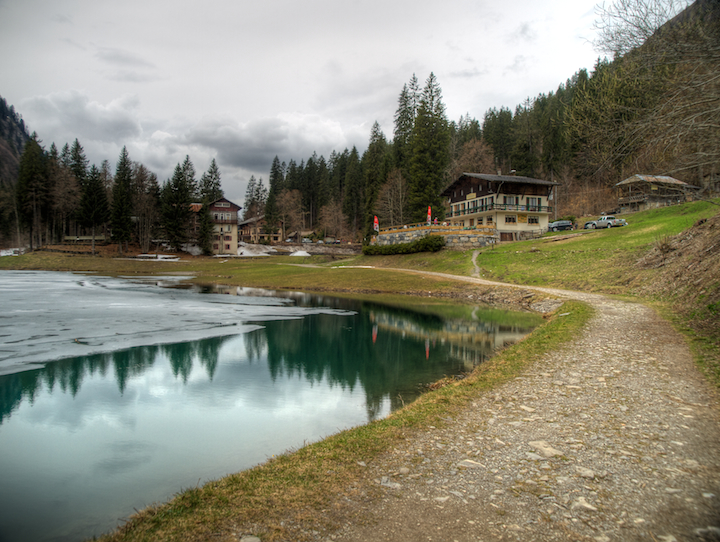
Olympus E-P1 Preview

Imaging Resource have got a preview of the new Olympus E-P1.

The E-P1 is a Micro Four Thirds format camera. Put simply, it’s a DLSR with the mirror removed to make a much smaller camera. The lenses are interchangeable and a 17mm f/2.8 and 14-42mm f3.5-5.6 will be available at launch in July. The sensor is the same 12.3 megapixel sensor used in the Olympus E-30 and E-620 DSLRs.

Also available will be an external flash (FL-36R and FL-50R will work as well), an optical viewfinder and adapters to connect OM and Four Thirds lenses to the Micro Four Thirds mount.

More on the Imaging Resource and Olympus sites

Hmmmm. Lust.

Solent Sunset

We’re having some fabulous sunsets on the South Coast. The photograph was taken this evening, in fact, it’s five photographs, each at a different exposure, blended together in a technique called High Dynamic Range (HDR).

Solent Sunset
Solent Sunset

[Update] Just after I uploaded this photo, I saw this article online – “There are at least 10 great pictures within 10 meters of you right now.” What a great idea! Anyway, I submitted my sunset…

This photo will probably appear on Picture of the Day in due course…

Moo Cards

I just wanted to put a shout out for Moo mini cards. They’re small business cards, probably more suitable for personal use than business as they’re less formal than the kind you get given in meetings.

Moo mini cards
Moo mini cards

Go to their web site, upload a few photos, and arrange the personal information that you want on the back. You order Moo mini cards in batches of 100 and the photos you select are divided equally, so you can upload anything from 1 to 100 images! You can see some great examples on Flickr.

I’ve been using them for a couple of years. £10 for 100.

Time-Lapse Photography Captures Galactic Core of the Milky Way

From gizmodo:

This gorgeous video is a compilation of shots taken with a Canon EOS-5D every 20 seconds over about nine hours at a star party in Fort Davis, Texas. It’s a humbling sight. Galactic Center of Milky Way Rises over Texas Star Party from William Castleman on Vimeo. Some specifics: The Canon was equipped with a fisheye lens (an EF 15mm f/2.8 lens) and powered with an external battery to capture all that goodness. The more interesting part is the replacement anti-alias filter the photographer, William Castleman, used: The Canon’s stock AA filter blocks out certain red wavelengths to achieve a “more desirable” skin tone, but if it’s replaced with a filter that lets those wavelengths in, you’ve got yourself a camera capable of shooting a galaxy, as seen here, even if we can’t see it with the naked eye. Really, really cool stuff. [Vimeo via Crunchgear]

Galactic Center of Milky Way Rises over Texas Star Party from William Castleman on Vimeo.